

Notes for the Table
The question usually arrives the same way. Someone has just learned the game, loved it, and gone looking for a set of her own. She finds one for $38, another for $160, and a third that a group member is quietly reselling for $350. All three are described as an American mahjong set.
Why are mahjong sets so expensive at one end of that range and ordinary at the other? The useful question is not whether a number is wrong, but what the higher number is buying. Most of the gap is explainable, and once you know where the money goes you can stop paying for the parts you do not care about.
A set is a bigger object than it looks
An American set carries more than 150 individual pieces, each one moulded or cut, faced, finished, checked and packed. They also have to match: identical in height, width and depth or the wall does not build cleanly, identical in back colour or a tile becomes recognisable face down. A batch that runs slightly off does not produce a slightly worse set. It produces a set with a defect in it, which is why tile inspection costs real money and shows up nowhere in the product photo.
Why small production runs cost more per set
This is the biggest driver behind boutique pricing and the one least visible to buyers. Tile manufacturing loads its costs at the front: artwork prepared to production specification, tooling or plates made, samples travelling back and forth across a long time zone gap, colours matched and re-matched until they are right. None of that gets cheaper at five hundred sets instead of five thousand. It just divides over fewer units.
One maker in a large player community, someone who plays, collects and now produces, laid this out after a run of posts complaining about boutique prices. Her point: by the time design, production, packaging and freight are paid, the margin on a small-batch set is far thinner than the sticker suggests. The post drew 864 reactions and 321 comments, which tells you how badly players wanted the explanation. A second maker post added that below roughly five thousand units, printing cost per set goes up rather than down.
None of this obliges anyone to buy an expensive set. It means a small-run designed set is not a marked-up cheap set. It is a different cost structure.
Carved versus printed faces
Two sets can look nearly identical in a photograph and differ sharply in price because of how the face is made. A printed face sits on top of the tile: cheapest route to complicated artwork, and the first thing to scuff, fade or lift after a few seasons of shuffling. A carved face is cut in and filled with colour, so it holds its edge. Carving costs more in tooling and in time per tile, and that lands in the price.
Neither is automatically right. For a teaching set that lives in a tote, printed is a sensible economy. For the set a group plays on monthly for a decade, the carved face is the part of the premium that keeps paying. Our guide to mahjong tile size and readability goes further into how to judge a face before you buy.
Why Are Mahjong Tiles So Expensive?
Strip away the box, the racks and the artwork, and the question gets simpler: why does a single tile cost what it does? Four things, mostly.
The material has to do two jobs at once. A tile is a small block that gets picked up, shuffled face down and clicked against its neighbours for years, so it has to be dense enough to feel like something and hard enough not to chip. It also has to take colour evenly on the face and stay one uniform shade on the back. Cheap resin does the first job badly and the second unevenly, which is why bargain sets so often feel light in the hand and show two slightly different backs in the same wall. The compounds that do both jobs cost more per kilogram, and a set uses close to a kilogram of them.
Every face is finished by hand or by a tool that was made for it. A printed face is one pass. A carved face is cut, then filled with colour, then cleaned back so the fill sits flush, and for a suit with three colours that is three fills. Multiply the extra minute or two by more than 150 tiles and the labour on one set is measured in hours, not seconds, before anyone has packed a box.
One bad tile spoils the set, so inspection is not optional. This is the cost buyers never see. Tiles come off the line individually, but they are sold as a matched set, and a set with one flawed tile is a flawed set. The arithmetic is unforgiving: if even one tile in a hundred fails on colour, depth or a chipped edge, then roughly four sets in five would ship with at least one bad tile if nobody looked. So somebody looks, at every tile, and the tiles that fail are thrown away along with the material and labour already in them. Both the looking and the throwing away are in the price of the tiles that pass.
The tile count multiplies everything. A 152-tile set is 152 of each of the steps above. Add spares and it is closer to 160. A board game with sixty tokens can absorb a more expensive material or a slower finishing step without much moving the price; a mahjong set cannot.
What this means in practice is that tile cost sets a floor under a set's price rather than a ceiling. Below a certain number, one of the four things above has been skipped, and the tiles will tell you which within a season of play. Above it, the price is mostly about the run size and the artwork, which the sections above and below cover.
What cheaper sets leave out
Compare what is in the box, not what is on the label.
A warehouse club set at $99 set off a thread with more than 900 reactions in one large player group, and the top question in it was not about the tiles. The box shipped without racks. Racks are not optional in American play, so the real price was $99 plus racks, plus shipping, plus a second decision.
The recurring omissions:
- Racks or pushers. Often excluded, rarely mentioned in the title.
- Blank spare tiles. Without spares, one tile lost under a sofa retires the set.
- Reference material. A booklet and quick reference cards matter more than experienced buyers remember. Most sets are bought by people still learning.
- Storage that protects the tiles. A thin tote is not a fitted pouch.
- Any recourse if something is wrong. The one that costs most when it goes badly.
The loudest quality complaints in player groups are almost never about a tile arriving chipped. They are about what happened next. A seller who answers and replaces turns a bad batch into a story about good service. A seller who goes quiet turns the whole purchase into a loss.
How much does a mahjong set cost in practice
Rough bands, based on what players report paying:
Under $60. Basic tiles, usually printed, usually no racks. Useful as a first or teaching set. Players regularly build a full playable table for about $100 by starting here and adding a mat, racks and dice separately.
$60 to $130. The crowded middle. Better packaging, sometimes racks, artwork from plain to genuinely nice. Quality varies more inside this band than any other, which is why it produces the most disappointed posts.
$130 to $250. Designed sets from smaller makers. Carved faces become common, inclusions are usually complete, and there is normally a real company behind the purchase.
Above $250. Collector territory, limited runs and resale. Sets that sell out get relisted at two to three times their original price, which is a scarcity number rather than a cost one.
One caveat worth holding onto: the most expensive set in a room is not reliably the best one to play on, because artwork ambition and table readability are separate skills.
When paying more is worth it
How often will it be on a table? Monthly play for years justifies a durable face. Twice a year does not.
Can you read it at seven in the evening? In lamp light, from the far side of the table, not in the styled overhead photograph. This question disqualifies more expensive sets than any other.
Is the box complete, and is there someone to talk to if it arrives wrong? Count the tiles, look for spares and racks, then check for a published warranty and a real reply address.
Where our set sits
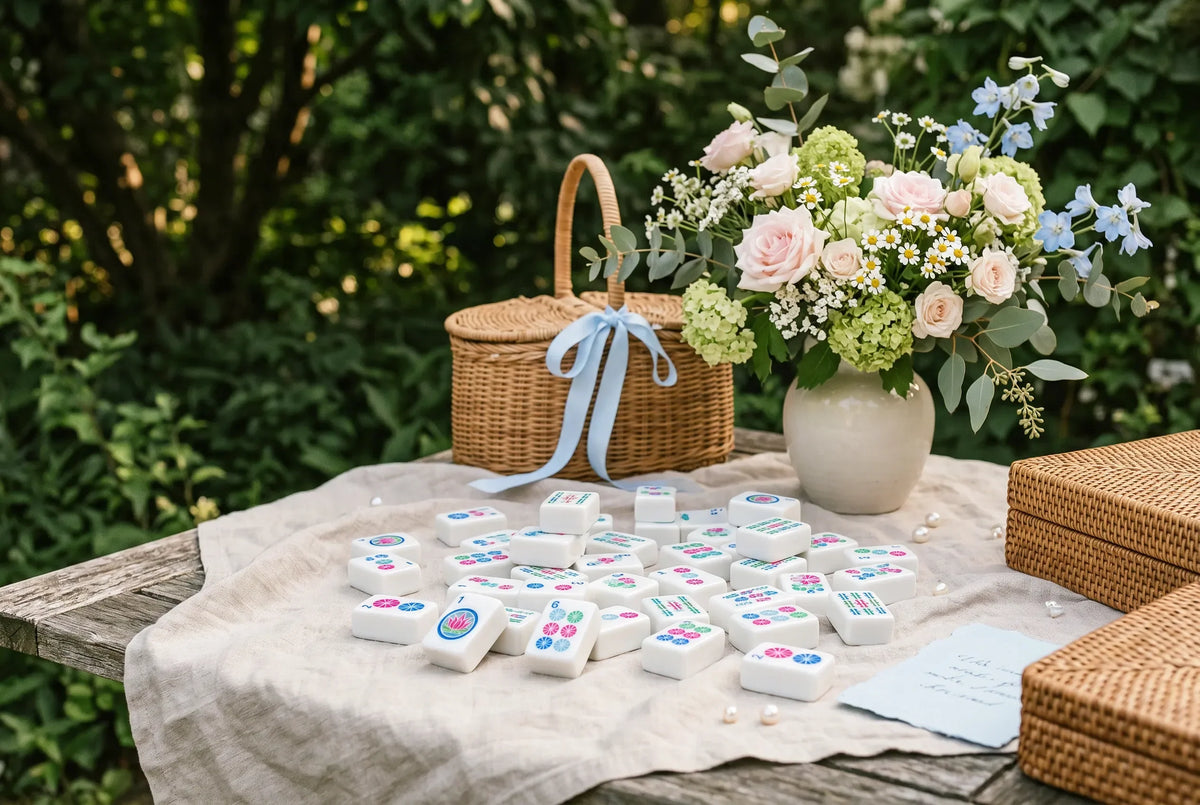
We built the Averill Mahjong Set in Monet's Garden in the designed band. Here is what that pays for.
The set is 160 tiles: 154 in play plus six blank spares, so a lost tile is an inconvenience rather than a retired set. The faces are carved acrylic rather than printed, at 0.87 inches wide by 1.25 inches tall by 0.6 inches deep, which sits at the tall end of the ordinary American range instead of in oversize territory that stops fitting standard racks. The backs are a single uniform coral orange with no directional pattern. The box includes a zippered storage pouch, four quick reference cards, an instruction booklet and gift-ready packaging, and the set carries a 180 day warranty. Current pricing is on the product page.
The garden motifs draw on the impressionist garden painting tradition, which is in the public domain, and the illustrations are our own. The brief was a set that reads cleanly across a table, not the most elaborate artwork we could fit on a tile face.
FAQ
Why are mahjong sets so expensive compared to other board games?
Because a set is more than 150 precision-made pieces rather than a board and a few tokens, and because most designed sets are produced in small runs. Artwork, tooling, sampling and colour matching cost about the same at five hundred sets as at five thousand, so they land much harder on each set in a small batch.
How much should I spend on my first mahjong set?
If you are still finding out whether the game will stick, a basic set under $60 is a reasonable start, as long as you check whether racks are included. If you already play regularly, the designed band from roughly $130 upward is where carved faces, complete inclusions and a real warranty become normal.
Are expensive mahjong tiles always better quality?
No. Price tracks production cost and scarcity, and scarcity is not quality. Judge the face, the uniformity of the backs, the finish on the edges and the completeness of the box. A carefully designed set in the middle band often plays better than a limited-run set bought on resale.
One last thought
The most useful way to read the number is per evening. A set that comes out monthly for ten years is 120 gatherings, and almost any price in these bands divides down to less than the coffee. What you are deciding is whether the tiles will still be easy to read, and worth looking at, on the hundredth night.
Our guide to mahjong accessories worth owning covers what belongs on the table alongside the tiles. If you are shopping for someone else, mahjong gifts for game night hosts is the better starting point, and if you are buying a set to bring new players in, our notes on how to teach mahjong to beginners cover what a teaching set needs.