

Notes for the Table
Choosing the tiles is the decision everyone agonises over. What surprises most new players is how much of the evening is shaped by everything else on the table.
Racks that hold a hand at the right angle. A surface that lets tiles slide without announcing every move to the whole room. Something to keep 160 small objects together between games, which sounds trivial until the first time a set goes back in the bag one tile short.
Mahjong accessories are also where the most money gets wasted, because the category rewards impulse and punishes it later. Here is what genuinely earns a place on the table, in the order we would buy it.
Racks and pushers: the one thing to get right first
If you buy a single accessory, buy racks. A hand of thirteen tiles held in a rack is visible to you and organised in front of you, and a hand balanced against a stack of coasters is neither.
Pushers are the flat extensions that let you move the wall forward without reaching across the table. Sold as a pair with racks, they are the reason most players describe mahjong racks and pushers as a single purchase rather than two.
A few things worth checking before you order:
- Rack compatibility with your tiles. This is the most common and most annoying mistake. Racks are cut for a tile width, and oversize or extra large tiles frequently will not seat properly in a standard rack. Measure your tiles first.
- Wood or acrylic. Wooden racks are warmer, quieter, and more forgiving of a scratch. Acrylic racks are lighter, easier to wipe, and available in colours that can be matched to a set. Both work. Acrylic mahjong racks in a tinted finish are the usual choice when someone wants the table to read as one designed thing.
- Single or double. Double racks give you a second tier for exposures, which keeps a claimed pung visibly separate from the hand you are still building. Once a group starts playing the card seriously, this stops being a luxury.
- The pusher lip. A pusher with a slight lip moves a wall cleanly. A perfectly flat one tends to slide underneath the bottom row and knock it over, which is a small irritation that repeats all night.
A mat or table cover
A mahjong table cover does three jobs at once, which is why it is the accessory people are most surprised to find they care about.
It quiets the game. Bare tiles on a hard dining table are genuinely loud, and the washing of the tiles at the start of each hand is the loudest part. It protects the table, which matters more than usual because mahjong involves dragging and sliding rather than lifting. And it gives the tiles a consistent amount of grip, so a wall stands where you build it.
Neoprene backed mats are the practical default: they grip the table, they roll for storage, and they wipe clean. Felt is quieter and more traditional but slides more. Size is the thing to check, since a mat that overhangs a round table awkwardly is worse than no mat at all.
Storage, and the problem worth solving properly
This is where we would spend attention rather than money.
The recurring complaint in every mahjong community we follow is not that storage is hard to find. It is that most storage makes it impossible to tell whether the set is complete. A drawstring bag holds 160 tiles perfectly well and gives you no way to know, at a glance, that one is missing until the night you need it. One player summarised it exactly: she liked bags, but was always worried about how she would know if any tiles were missing.
That points to a simple buying rule. Prefer storage where tiles sit in visible rows or fitted trays, so a gap reads as a gap. A case or tray system lets you confirm a complete set in about four seconds. A soft pouch is excellent for carrying and poor for auditing, which is a reason to own both rather than to choose between them.
Whatever you use, count the set the same way every time: after the last hand, before it leaves the table, while there are still four people who can look under their own chair.
Carrying cases and travel
Mahjong carrying cases are worth it once you regularly play somewhere other than your own dining room, and not really before that.
What separates a good one is not the exterior. It is whether the tiles are immobilised. A case that lets tiles shift in transit will chip edges and dull corners over a few dozen trips, and edge damage is permanent. Look for fitted trays or a divided interior rather than a single padded cavity, and check that the closure holds under weight when the case is carried flat.
If your group rotates hosting, a case that also holds four racks changes the arithmetic of who has to bring what.
The paper things, which matter more than they look
The card is the one accessory that is not optional. American mahjong is played against the National Mah Jongg League's official hands, and the card is reissued annually, so a set of hands from two years ago is a set of hands nobody at the table is playing.
Around it, a few small items do disproportionate work. A card cover keeps a paper card usable through a full season of handling. Individual quick reference cards mean four people can check a hand family without passing one card around. And a printed rules booklet settles the question that always comes up around hand three, which is usually about jokers.
What should already be in the box
Before buying accessories separately, check what your set includes, because the answer varies widely and the gap is where budgets disappear.
At minimum, a complete American mahjong set should give you all 160 tiles, meaning the 152 in play plus spare blanks, and the current official hands and rules card. Better sets add per-player reference cards, a rules booklet, and storage that lets you verify the set is complete.
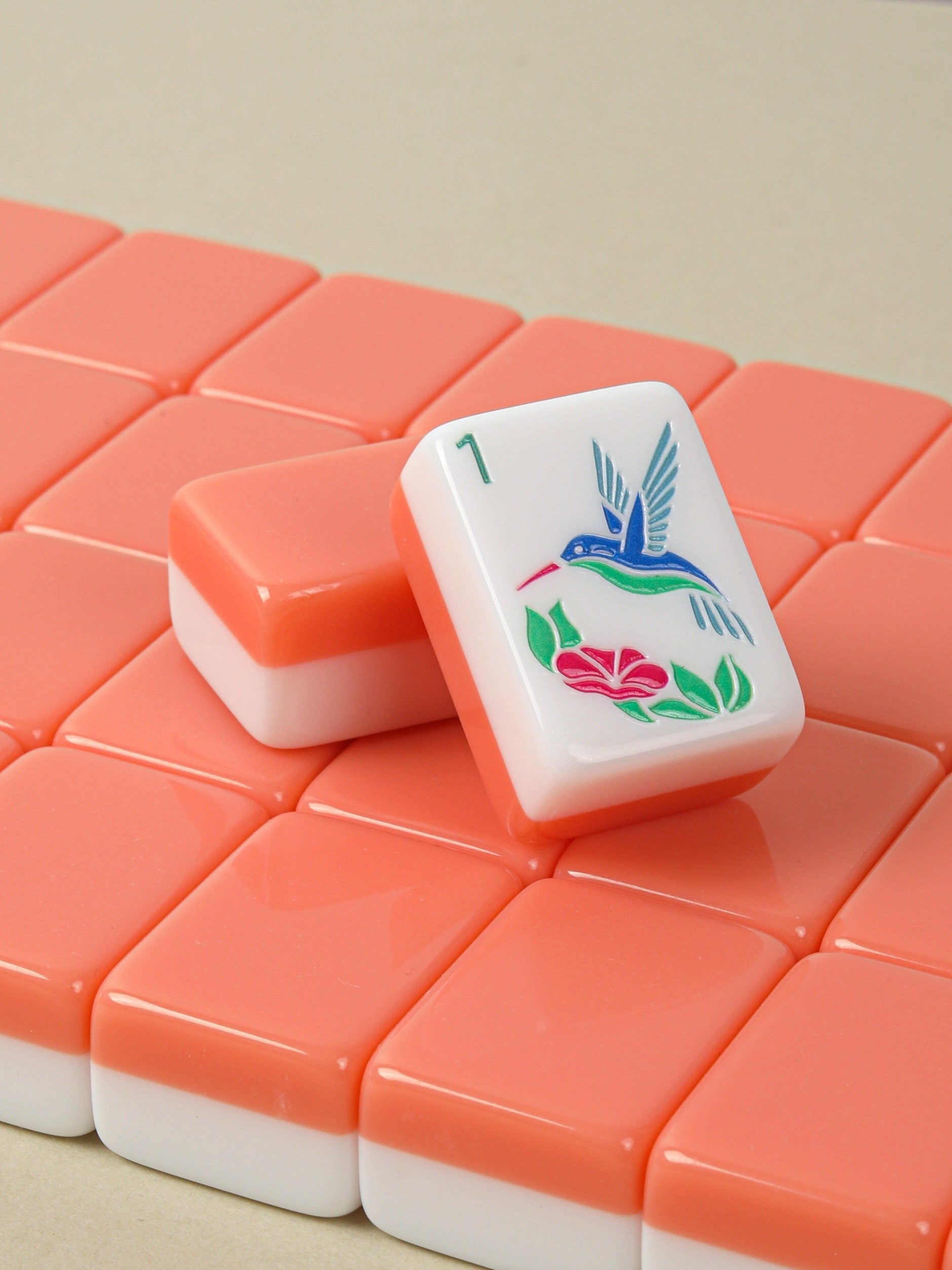
The Averill Mahjong Set in Monet's Garden ships with 160 carved acrylic tiles, the Official Standard Hands and Rules card, four quick reference cards, an instruction booklet, and a zippered pouch, in gift-ready packaging. Racks, pushers, and a mat are the pieces most players add alongside it, and because the tiles are a standard 0.87 by 1.25 inches, they seat in ordinary racks without a compatibility hunt.
FAQ
What accessories do you actually need to play American mahjong?
Tiles, four players, and the current National Mah Jongg League card. Everything else improves the evening rather than enabling it. If you are adding one thing, add racks with pushers. If you are adding two, add a mat.
Do I need racks and pushers, or just racks?
Racks are the essential half. Pushers only matter once your group builds a full wall each hand, but they are almost always sold together, so the practical answer is to buy the pair and grow into the pushers.
What is the best way to store mahjong tiles?
Whatever lets you see that the set is complete. Fitted trays or visible rows let you spot a missing tile immediately, which a loose bag does not. Many players keep both: a case for storage and auditing, and a pouch for carrying.
Buy slowly
The table people remember is rarely the most equipped one. It is the one where the hand is easy to hold, the tiles are easy to read, and nobody spends the last ten minutes of the evening looking for a missing Three Crak.
If you are choosing tiles rather than accessories, our guide to mahjong tile size and readability covers what to look for in the set itself, and our beginner's guide to American mahjong covers the rules the accessories are there to serve.